
Home » Modern technology is transforming India’s construction industry
Construction in India has always moved with time, but not always with intention. For years, the industry relied on what was familiar. The industry relied on familiar materials such as bricks, blocks, and plaster and the hope that everything would hold together. Occasionally they did, or they didn’t.
At NCL Industries Limited, we’ve been part of construction sites long enough to know one thing. When a building fails early, it’s rarely because of design alone. More often, it’s because materials were chosen without thinking about how they would behave five or ten years later.
That thinking is changing now.
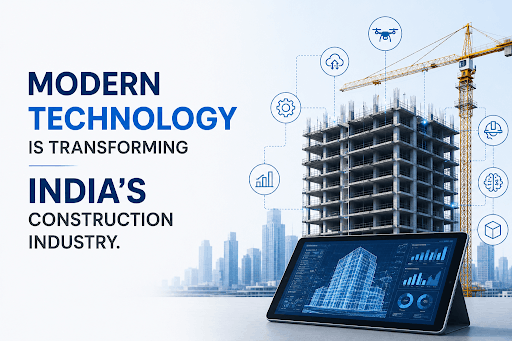
Construction today is under pressure. Timelines are tighter. Buildings are taller. Clients expect fewer defects and longer life. At the same time, weather conditions are getting harsher. Heat, rain, moisture, and pollution don’t give buildings any rest.
Earlier, these issues were accepted as normal. Cracks were “expected”. Dampness was “manageable”. Today, that mindset doesn’t work. Complaints come faster. Repairs cost more. Reputations suffer.
This situation is where material technology has quietly started playing a bigger role.
On-site work depends on too many variables. Labour skill. Weather. Curing time. Supervision. Even a small miss shows up later.
Engineered materials reduce that uncertainty. They behave the same way every time because they are made under controlled conditions. That predictability is valuable.
Such behaviour is one reason cement-bonded boards started appearing more often in modern projects.
A Bison Panel is not a magic solution. It simply does some things better than traditional options.
It stays dimensionally stable. It handles moisture better. It offers fire resistance. And it doesn’t depend heavily on perfect site conditions to perform.
Because of this, a Bison Panel is now commonly used for partitions, ceilings, cladding, and facade-related applications. Builders use it where they want fewer surprises later. Architects use it where consistency matters.
Exterior surfaces take the maximum beating. The exterior surfaces are exposed to the sun for the entire day. Rainfall persists for months. The humidity remains constant. Pollution settles on surfaces year after year.
Traditional materials often show fatigue early in these conditions. Repairs become routine. Visual quality drops. Maintenance budgets increase.
An Exterior Bison Panel is designed with these realities in mind. It performs better when exposed to weather. It doesn’t swell or deteriorate easily. Over time, this stability becomes very noticeable.
That’s why Exterior Bison Panel usage has increased across residential and commercial projects where long-term performance matters.
Materials don’t work in isolation. They work together.
NCL Pearl represents our approach to supporting modern exterior construction where durability and surface performance are important. It complements exterior panel applications by helping maintain finish quality and consistency over time.
When Exterior Bison Panel systems are supported by NCL Pearl solutions, the exterior behaves more predictably. That predictability matters when projects scale up, and buildings are expected to age uniformly.
On-site, speed matters. Delays cost money. Rework costs even more.
Exterior Bison Panel installations reduce reliance on wet construction and long curing cycles. That helps maintain schedules. It also reduces dependency on ideal weather conditions.
A Bison Panel also offers resistance to fire, moisture, and termites. These are not features written in brochures. These are issues faced on real sites.
Sustainability is often discussed in big words. On-site, it comes down to something simple. How habitually will this fixture need repair?
Materials that fail early consume more resources over time. Durable materials reduce that cycle. An Exterior Bison Panel supports this thinking by holding up better under exposure.
When combined with NCL Pearl systems, it helps reduce recurring maintenance and improves the overall life cycle of the building.
Construction professionals today are asking better questions; it’s not just about cost but about performance over time.
At NCL Industries, we see this shift every day. Builders are more cautious. Architects are more specific. Developers are thinking beyond handover day.
NCL Pearl and Exterior Bison Panel solutions exist because modern construction demands reliability, not assumptions.
India’s construction industry is changing because it has to. Buildings are expected to perform better, last longer, and age with fewer problems.
Material choices play a major role in that outcome. What is selected today decides how a building behaves tomorrow.
At NCL Industries, our focus remains grounded in real-world performance. Through solutions like NCL Pearl and Exterior Bison Panel, we continue supporting construction that is built to last, not just to finish fast.
Generally, Bison Panels are utilised for partitions, ceilings, facades, and other applications where stability is crucial.
Because it handles moisture, heat, and weather exposure better than many traditional options.
It complements panel systems by supporting durability and surface consistency.
Yes, they are designed with Indian climate challenges in mind.
Yes, better stability leads to fewer surface failures over time.
©2024 NCL Industries All Rights Reserved. Privacy Policy