
Home » The Role of AI in Construction Project Management
Why is intelligence alone not enough? There is a moment in every project when the plan meets reality.
Drawings look perfect on paper. Budgets look manageable. Timelines look comfortable.
Anyone who has managed a construction site knows this feeling. It is controlled chaos.
For years, projects moved forward because experienced people held everything together. They relied on judgement. On memory. On instinct.
Now, artificial intelligence is entering this space.
At NCL Industries, we see it not as disruption but as reinforcement. AI does not replace the builder. It strengthens the builder’s decisions.
But there is something we believe strongly.
Intelligence without reliable materials creates risk.
Technology can guide a project. Materials determine the outcome.
Not careless guesswork. Experienced guesswork.
Project managers would review past projects to estimate time and cost. Most of the time, they were close. Occasionally, they were not.
AI changes the situation by looking deeper than memory can.
It studies thousands of data points, labour trends, material costs, supply timelines, and weather history. It spots patterns humans may overlook.
This technique makes scheduling tighter. It makes procurement smarter.
But AI predictions depend on consistency.
If material performance varies, the data loses meaning.
When contractors choose NCL Pearl, they choose cement that behaves the same way, project after project. That reliability makes forecasting stronger. When strength gain follows predictable curves, AI-based planning becomes practical.
At larger sites, differences matter more than most people realise.
Earlier, progress reports came at the end of the week. Problems were discovered late.
Now dashboards update daily. Sometimes hourly.
AI systems monitor movement. They measure output and compare planned progress with actual progress.
Managers no longer wait to see issues. They see them forming.
But again, systems are only as strong as execution.
Take exterior applications.
Designer software can optimise cladding layouts. It can reduce material waste and model wind resistance. But if the physical product shifts under weather stress, design precision becomes meaningless.
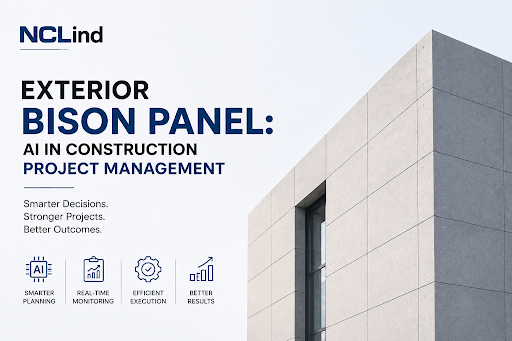
The exterior bison panel is built to handle real environmental conditions. It does not rely on ideal situations. The exterior bison panel performs even when exposed to moisture and heat variations.
In data-driven construction, physical reliability is non-negotiable.
AI can optimise design. The exterior bison panel ensures that optimisation is maintained throughout the installation.
In most projects, material waste does not come from one big mistake.
AI identifies these patterns. It tracks how much was planned and how much was used. It highlights unusual spikes.
But the nature of the material still influences the outcome.
A strong bison panel reduces handling damage. A durable panel lowers replacement needs.
The same applies to structural materials.
When workability changes, usage changes. When curing time shifts, schedules move.
At NCL Pearl, contractors consistently exhibit mixed behaviour. That predictability reduces on-site adjustments. When AI systems track consumption rates, NCL Pearl supports more stable data patterns.
Over time, this stability tightens budgets.
Not dramatically. Gradually. But consistently.
AI tools now monitor safety risks. They flag unsafe movement. They detect unusual equipment positioning.
Such detection improves awareness.
But structural safety still begins with material performance.
Engineers model load-bearing capacity using defined strength values. If actual material behaviour shifts, structural assumptions will weaken.
The performance record of NCL Pearl supports dependable structural output. Strength curves NCL Pearl remain stable. That matters in high-load applications.
Exterior durability affects safety, too.
The exterior bison panel resists environmental stress. It holds dimensional integrity over time. The long-term reliability of the exterior bison panel reduces maintenance-related risk.
AI can predict lifecycle performance. Durable materials make those predictions realistic.
There is a narrative that technology will automate construction decisions.
That is unlikely.
Construction remains physical. It remains human and requires supervision, coordination, and responsibility.
AI helps managers see more clearly. It reduces blind spots. It strengthens analysis.
At NCL Industries, we see technology as support, not authority.
We have seen industry shifts before. Methods change. Tools improve. Expectations rise.
That is why NCL Pearl continues to support structural applications across varied project types. Builders trust NCL Pearl because it performs without surprises.
That is also why the Exterior Bison Panel aligns with modern façade requirements. The exterior bison panel supports design flexibility while maintaining strength.
In projects managed by data, predictability becomes power.
Construction project management will become more analytical.
Procurement systems will anticipate shortages. Schedules will adjust automatically. Risk alerts will arrive early.
But projects will still succeed for the same reason they always have.
At NCL Industries, we recognise that connection.
With NCL Pearl strengthening structural reliability and the Exterior Bison Panel supporting resilient exterior systems, we stand aligned with the direction construction is moving.
AI sharpens vision. Experience guides action. Quality materials complete the structure.
That combination defines the next phase of construction project management.
Yes, some already are. According to many project teams, it helps them look at schedules, track progress, and review what happened in earlier projects.
Not fully. Delays can still happen. What AI does is show possible risks earlier, so managers get a little more time to react.
In the end, the building relies heavily on the materials it uses. Software can help with planning, but strength still comes from the products on site.
You will usually see them in exterior cladding, wall systems, and partitions where durability is important.
Very unlikely. Construction sites still depend a lot on experienced people making day-to-day decisions.
©2024 NCL Industries All Rights Reserved. Privacy Policy